Ldg Seaman Peter Shorer
Printed From: BMPT Forum
Category: General Discussion
Forum Name: Where Are The Personnel Now
Forum Description: Tell everybody where those old buddies are
URL: http://www.bmpt.co.uk/forum_posts.asp?TID=351
Printed Date: 26 March 2026 at 7:57pm
Topic: Ldg Seaman Peter Shorer
Posted By: Pioneer
Subject: Ldg Seaman Peter Shorer
Date Posted: 23 May 2007 at 9:04am
|
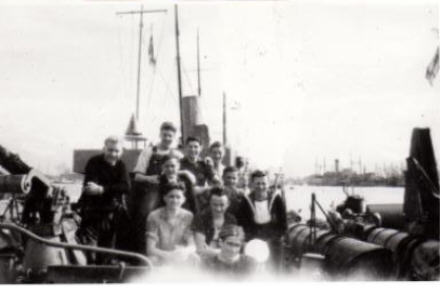
The Crew of MTB 398 in the Med The crew members in full photo from the left top is Chalky White, TM (Trained Man); Bill Baker, Stoker; Michael Munns W/op; Unknown; in front of Bill Baker is Motor Mac(name unknown); Coxswain; (name unknown); Peter Jordan TM;(from Ilford.); in front of Motor Mac is Wine gum Tommy,TM,(worked at Rowntrees and daily had an apron pocket full of wine gums, which we said he stuck to his protruding front tooth to suck them and make them last longer); to his left Ginger Wadey, Stoker; in front of him Geordie Monegan AB, from Geordie land I believe the unnamed one may be the Scotch Gunner who put the fore sight on the left Vicker’s K and the rear sight on the right Vicker’s K (Vicker’s K were a pair of .303 machine guns on the starboard 21" Torpedo Tube, and also on the Port Tube for the Trained man to operate when occasion arose). I volunteered at 18 and was turned down unfit for all purposes, due to rheumatic fever as a child. Six months later I received my call-up papers to report, and was sent to a heart specialist who said I was medically unfit, but physically fit so he gave me the option of 'in or out'. I said "get me into the Navy and I'm in" which he did. By When the war finished in
(Some of the actions that this boat was involved in are described in "Mediterranean MTB's At War" by L Reynolds and H Cooper - Pioneer)
------------- Pioneer - Forum Moderator |
Replies:
Posted By: johnk
Date Posted: 23 May 2007 at 12:58pm
|
Hi Pioneer,
Many thanks for the above, despite the option of not going to war, Mr Shorer went!.
John |
Posted By: Pioneer
Date Posted: 15 June 2007 at 2:03pm
|
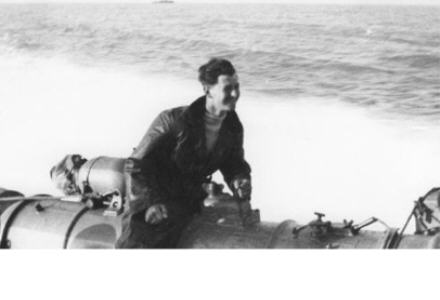
I have had the good fortune to be able to prove what was fast becoming a 'myth'. I myself could just not believe the story of somebody 'riding a Torpedo Tube'. Having had first hand knowledge of a 'Short Boat' at speed and knowing of the 'buffeting' that would certainly be risked if attempting that very dangerous antic - Peter Shorer has proved me wrong - Here is a shot of him on MTB 398 in the Med 1944.
------------- Pioneer - Forum Moderator |
Posted By: tramontana
Date Posted: 18 June 2007 at 3:08pm
| One of the best books I have read about the Coastal Forces in the Med during the War is "Flag 4" by Dudley Pope, a really good read and a good reference book toboot |
Posted By: Pioneer
Date Posted: 30 October 2007 at 2:08pm
|
It truly is amazing what talent is ‘out there’. Having only very recently been introduced to Peter Shorer – the Ex Leading Seaman who had a predisposition for riding Torpedo Tubes - (I still can’t quite believe that, although having seen the proof!!) – Peter has kindly given me permission to relate this story as it refers to Malta GC. Very recently (Sept ’07) CFVA had a plaque dedicated to HMS Gregale, the wartime Coastal Forces base on Malta. [An article should appear in the next (December) CFVA ( HMS Illustrious is greatly revered in Malta GC, because that Aircraft Carrier was central to the relief of the Siege of Malta in 1943. The forth ship to bear the name (now five) the ‘Illustrious became severely battle damaged. Its then Captain saw the state of its Ship's Bell and had it sent back to the National Maritime Museum as an interesting war relic that dramatically showed its signs of battle scarring by shell and shrapnel. (The forth HMS Illustrious was to survive the war, being ‘paid off’ and ‘broken’ in the mid ‘50’s). In 1976, Malta GC asked the A Mr John Munday (then in charge of such items at NMM) asked Peter Shorer if he could make a reproduction of the The original
He took the original, and the replica, back to the NMM and was met on the steps by the Duke of Edinburgh; (Patron of the Trustees). He asked "Which is your reproduction?" He commented "How did you do that?" and "Well done" (The first image shows the Duke of Edinburgh having details explained by Peter at the NMM) This occurred thirty years after the war had finished, but Peter strongly felt that moment as - ‘having once been a Leading Seaman and here he was talking to an Admiral – (having to explain what he did’). As a CF veteran Peter still has respect for Rank, and an appreciation of what they are being told. Peter and his wife took the replica to Malta G.C. with that photo attached to the box. When Customs knew what was inside, and after he had said "This is me", - the Customs Man said " and this is -------?" pointing to D of E. They carried the box and ushered them both out to a waiting taxi and set them on their way. It was finally handed to a gentleman who was to present it to the Museum later in the week. Peter states that he and his wife Audrey then went on to enjoy Malta (as it was thirty years ago) and while it was a bit different to his first visits, the Gut, which was without its clip Joints, and Eateries "Steak and Chips, Johnny?" and Blue Label and chemical beer, had reverted back to its previous name of "Strait Street". When Peter’s replica was presented it was a Brassy colour with ‘scorch’ colours relating to its battle-worn history. It had not been painted Battle Ship Grey during its war service life, so it remains a mystery why someone has seen fit to paint it in the current false grey colour.
As currently displayed. ------------- Pioneer - Forum Moderator |

