Coastal Forces in Paper
Printed From: BMPT Forum
Category: General Discussion
Forum Name: Modelling
Forum Description: Discussion about Modelling
URL: http://www.bmpt.co.uk/forum_posts.asp?TID=445
Printed Date: 26 March 2026 at 11:36pm
Topic: Coastal Forces in Paper
Posted By: Horst
Subject: Coastal Forces in Paper
Date Posted: 05 November 2007 at 5:47pm
|
Hi, a few months ago I started a website with paper model kits of coastal forces vessels, mainly based on Lambert-plans. I would be glad if some of you would visit the site and I'm looking forward to hearing any comments or suggestions. The site is available in German and English. http://cfp.muerell.de - Here is the link Regards, Horst ------------- Coastal Forces in Paper http://cfp.muerell.de - http://cfp.muerell.de |
Replies:
Posted By: Christian
Date Posted: 05 November 2007 at 7:42pm
|
Hi Horst I came across your site recently, I have to say the models look great the thing which stopped me buying a few was a comment along the lines of them being for advanced card modellers only. Could you not perhaps include a very simple vessel, e.g. a Higgins Boat landing craft, which we could buy to practice our skills upon? Ideally it would include instructions suitable for first timers. Will you expand the range to include MTBs? Kind regards, Christian.
|
Posted By: Roger P
Date Posted: 07 November 2007 at 8:44am
|
To Christian and others contemplating the purchase of these very fine models. Firstly let me say, don’t be put off by the comment “A CFP-model should not be your first card model. Knowledge of the basic techniques of card modelling is required. Advanced card-modellers won’t have problems with the models, but because of the small scale there are some very small parts to be handled”. The instructions are excellent and Horst (the owner of ‘Coastal Forces in Paper’ is only an e-mail away. Here is a hint which I am positive any first time purchaser will find VERY useful. “Initially, DON’T use the original kit as supplied, photocopy the thicker page of parts onto 250gsm card (the same thickness as your business cards) and I would suggest photocopying the thinner page onto something like 160gsm card which is only marginally thicker than paper”. These two thicknesses of card will go through a photocopier or you computer printer with no problems at all. The other ‘tools’ you will need are – a cutting board, a good quality knife with snap-off blades, a metal straight edge (ruler), a good quality PVA glue and finally a supply of toothpicks for applying and spreading the glue. By doing this, more than once if need be you can practice as many times as you need before turning to the actual model itself and being pre-coloured no painting or touching up is needed. Once you have mastered the techniques needed I am certain you will not stop at just one kit. I for one will be buying most of the available kits and I know he has more interesting models “in the wind”. I am ‘playing’ with some of these kits, rescaling them up to 144th scale and in two cases (so far) to the larger again 72nd scale. I have been experimenting with different thicknesses of card for the larger scales and I have to say, the detail in these kits is, in my humble opinion very good indeed. The formulas I use to rescale card kits is: Original scale (250) divided by desired scale (in my case 144th), and if you need to get the decimal point in the right place, multiply by 100. That is 250 divided by 144 then X 100 = 173.61% I have found however that merely using the above percentage formula is not quite accurate and I choose to do the following. To get your rescaled model to a more accurate length I use the following formula: Boat length in feet X 304.8 (the number of millimetres per foot) then divide by the scale you are working in. For example, the Fairmile C class MGB is a 110 foot boat/ship. Some say a boat becomes a ship when she is over 100 feet long. Others have mentioned to me a boat becomes a ship when she carries her own lifeboat. 110 x 304.8 divided by 144 = 232.83mm (close enough to 233mm). There you have it, my thoughts on ‘playing’ with card models. Thankyou Horst for producing models of little known subjects.
------------- Roger Pearson. Bendigo, Victoria, Australia. "Roger's Little Ships". Modelling Allied Light Coastal Forces 1914-1945. |
Posted By: Horst
Date Posted: 07 November 2007 at 2:58pm
|
Thank you, Roger, for giving the answer I should have given. I think you are right, anyone who is familiar with plastic modelling in small scales can also assemble a paper model. The parts will have to be cut out, scored and folded. I added this "warning" only because the instructions don't include basic techniques of card modelling. For those who want to practise paper modelling I can recommend a free download of an admirable-class minesweeper on http://www.digitalnavy.com/html/downloads.html - Digital Navy's website , a beautiful model which I myself built several times. To start with one of my models I would chose the Fairmile A ML100, the most complex one is in my opinion the minesweeper. Christian, there is no MTB planned in the near future. My interest lies currently more in the Fairmiles and in other small service craft. But perhaps this will change. Kind regards, Horst ------------- Coastal Forces in Paper http://cfp.muerell.de - http://cfp.muerell.de |
Posted By: Horst
Date Posted: 01 December 2007 at 9:50am
|
New: Armament Carrier Mortar (1943) Hello, CFP has released a new card model kit, the British armament carrier MORTAR, one of a class of 5 freighters ordered by the Admiralty. Mortar was built by James Pollock, Sons & Co., Faversham, Kent, delivered Dec. 1943. She was designed to the lines of a small coastal freighter, which were well known trading along the British coast. After the war Mortar served on the Clyde and was sold in 1973. More information: cfp.muerell.de Best regards Horst  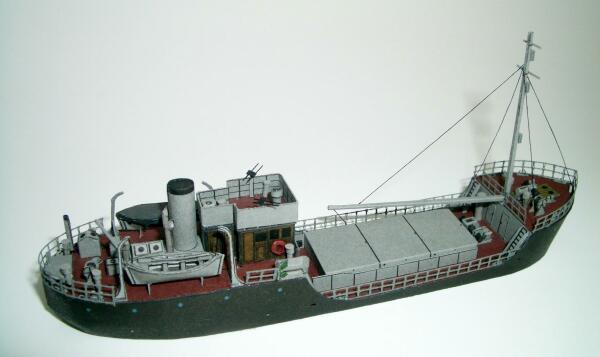 ------------- Coastal Forces in Paper http://cfp.muerell.de - http://cfp.muerell.de |
Posted By: Horst
Date Posted: 01 March 2008 at 8:17pm
|
Free download model: Admiralty MFV Hello, I'm happy to announce that there is now a free download model available at CFP. It's an Admiralty 61.5ft Motor Fishing Vessel, which can be built in different versions as a fleet tender or a civilian fishing vessel. The model is designed to be printed on coloured paper. The photo shows the fleet tender, printed on light grey paper. Please visit my website for details: http://cfp.muerell.de/product/category/3 - http://cfp.muerell.de/product/category/3 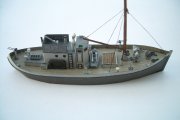 Regards Horst ------------- Coastal Forces in Paper http://cfp.muerell.de - http://cfp.muerell.de |
Posted By: Roger P
Date Posted: 14 June 2008 at 1:11am
|
To Christian and any others wondering about MTBs etc.
I now have a nice 72'6" Vosper MTB kit by Pro-Model which I have converted into a 70' boat, a 63' MGB by AH I think it is. This kit is very detailed as it is 1/50 scale plus I have two PT Boat kits, one is the 80' Elco by Answer and the other is a 70' Elco which I'm certain I can convert into the RN MGB and MTB versions. The Vosper kit and the PT Boats are 1/100 scale, but being card kits I have discovered I can rescale them to whatever scale I want. I am doing the majority of my models in 1/144th scale plus a number in 72nd and 35th scales !!! ------------- Roger Pearson. Bendigo, Victoria, Australia. "Roger's Little Ships". Modelling Allied Light Coastal Forces 1914-1945. |
Posted By: Horst
Date Posted: 05 September 2009 at 9:09pm
|
Vosper Motor Torpedo Boats Hello, at the end of the summer holidays there comes a new model from CFP, the well known Vosper MTB in two versions. More here: http://cfp.muerell.de/product/details/26 - http://cfp.muerell.de/product/details/26 switch to the english version by clicking on the flag on the left Horst 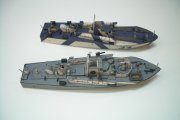 ------------- Coastal Forces in Paper http://cfp.muerell.de - http://cfp.muerell.de |
Posted By: Horst
Date Posted: 24 January 2010 at 6:50pm
|
Fairmile D MTB Hello, the well known Fairmile D is now available at CFP. More here: http://cfp.muerell.de/product/details/29 - http://cfp.muerell.de/product/details/29 Horst 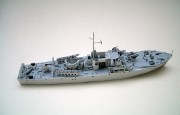 ------------- Coastal Forces in Paper http://cfp.muerell.de - http://cfp.muerell.de |