HYDROFOIL R-103 - Bras D'Or
Printed From: BMPT Forum
Category: Boats (In alphabetical order)
Forum Name: High Speed Launches
Forum Description: Discussion on High Speed Launches
URL: http://www.bmpt.co.uk/forum_posts.asp?TID=774
Printed Date: 26 March 2026 at 8:04pm
Topic: HYDROFOIL R-103 - Bras D'Or
Posted By: mprints
Subject: HYDROFOIL R-103 - Bras D'Or
Date Posted: 02 August 2011 at 7:56am
|
Saunders-Roe factory in Anglesey not only built the first aluminium experimental MTB P1602 for the Royal Navy's Coastal Forces in 1948 and later became the lead company in designing and building a number of the famous 'Dark Class' FPB's, but they also built this one-off experimental hydrofoil for the Royal Canadian Navy in 1957. Named BRAS D'OR, she was built like P1602 with a riveted all aluminium alloy hull. An entry in Wikepedia claims the hull came from an old Saunders-Roe or even Vosper hull. This as you will see from the photos is completely wrong. It was specially designed for the job and had an extremely narrow transom that was very heavily reinforced to carry the single rear steerable ladder foil. The front pair of foils were mounted on a transverse beam that ran through the for'd section of the hull. It was recently confirmed that the foils were made of Monel metal, an alloy of very high nickel content. This is said to be difficult to work, but has good strength and corrosion resistance. I remember when I was an apprentice at Saunders-Roe in the '60's being given a very small piece of the last remaining stock of monel from the Bras D'Or project to make a pair of engineer's caliper blades as we all had to make out own tools in those days. Only the best apprentices got a piece of monel off the supervisor  Bras D'Or was powered by a pair of Rolls Royce Griffon engines. Each engine had its output shaft facing its mate and between them a pair of 90 degree gearboxes took two dive shafts vertically down through the keel-like structure to the power pod, a cigar-like casing at its base. At each end was a propeller. The front one was of variable pitch while the rear one was fixed. I assume the front one could be used for slow speed reversing and manouvering and assisting the rear prop to drive the hydrofoil up onto its foils. When up and flying the front engine could be throttled back and the prop set to feather when the engine was shut down. The rear engine and prop would then take over as less power would be required during 'flight'. To see a collection of photos of her please see the Coastal Forces Veteran's Website: http://cfv.org.uk/forum/viewtopic.php?f=25&t=246 - http://cfv.org.uk/forum/viewtopic.php?f=25&t=246 You can also see more on my own website: http://dave-mills.yolasite.com/saro-hydrofoil-bras-dor.php - http://dave-mills.yolasite.com/saro-hydrofoil-bras-dor.php ------------- Dave Mills |
Replies:
Posted By: mprints
Date Posted: 02 August 2011 at 8:19pm
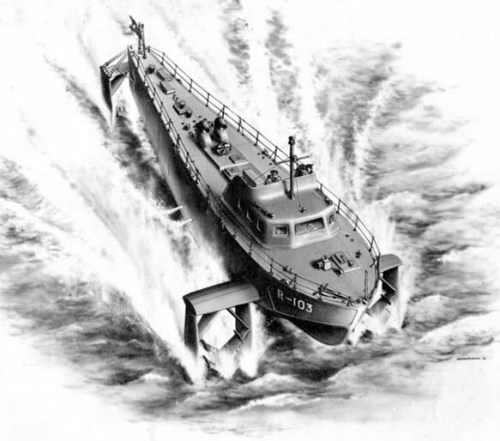 Bras d'Or R-103 from an artists illustration. 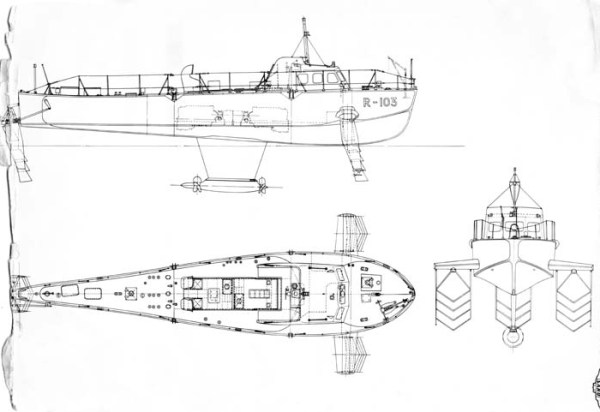 These views clearly show the most unusual hull design around her transom. This was very narrow to aid the strength required to carry the steerable rear ladder foil. 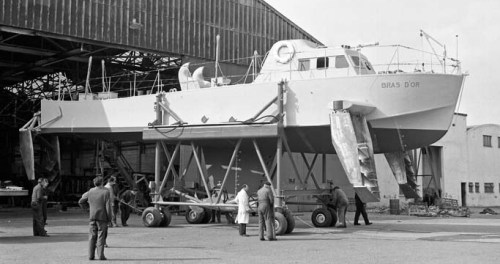 Leaving the workshop on her special trolley. 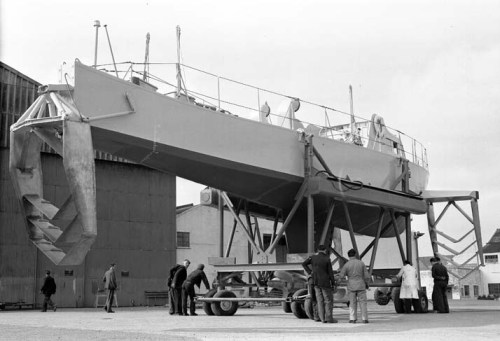 An excellent view of her narrow hull and rear foil with steering arm on the starboard. 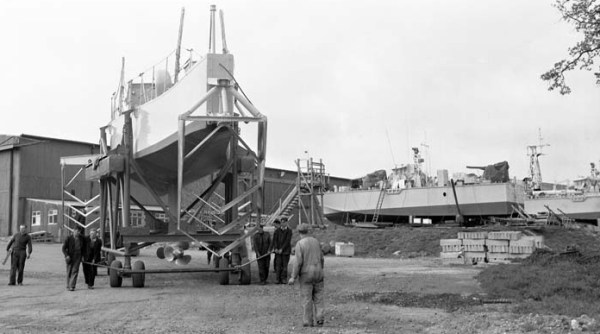 Bras d'Or being man handled towards the slipway with a pair of the five Burmese riveted aluminium FPB's in the background (T201-T205) 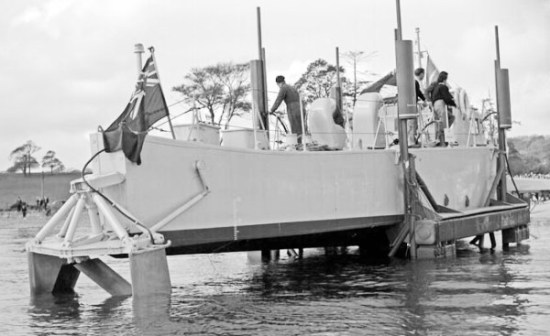 Entering the cold waters of the Menai Strait in 1957. 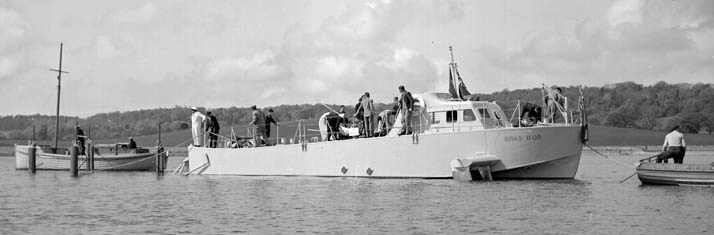 Nearly ready to fire up the two Rolls Royce Griffon petrol engines. 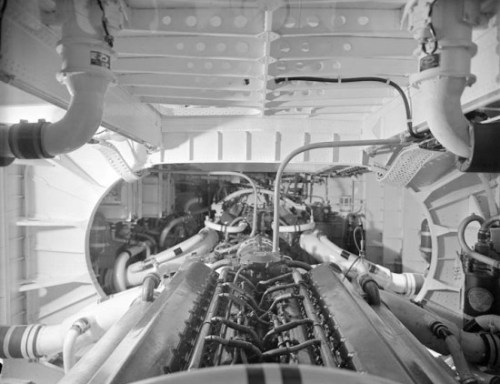 Rolls Royce Griffon engines packed end to end in the narrow hull. Notice the massive stiffening frames. 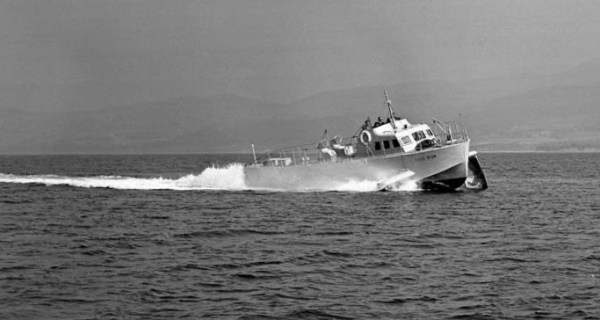 R-103 tacking a dive to startboard on the Menai Striat. She had initial stability problems that were only resolved after experiments were carried out in Canada. 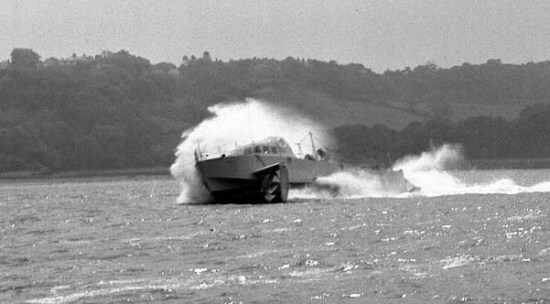 Another big splash and no doubt a very scarry experience at speed! 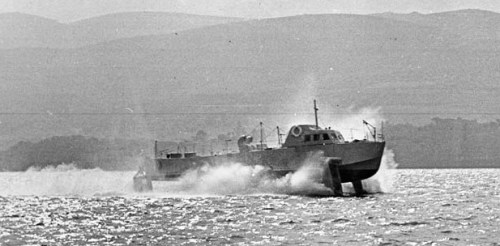 Nice and level on this run westwards. 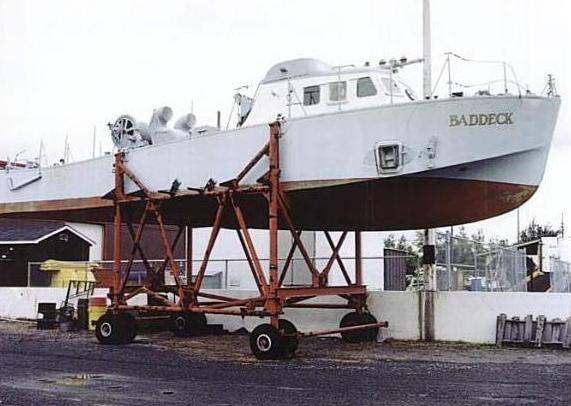 Remnamed Baddeck in 1962 to allow her original name to be transferred to the new gas turbine hydrofoil FHE 400. Baddeck now languishes at the Ottawa Museum of Science and Technology without her engines. The museum had informed me that the foils and drive pod do exist, but there appears to be no plan to have her restored. ------------- Dave Mills |
Posted By: mprints
Date Posted: 11 August 2011 at 10:04pm
|
There is an excellent book 'Fastest in the World' by John Boileau on the Saga of Canada's Revolutionary Hydrofoils. I have just borrowerd a copy from my library and find it totally absorbing. It covers the experimental work of Alexander Graham Bell and 'Casey' Baldwin who developed 'hydrodromes' and Bell called them from the early 1900's. It was in the early 1950's that the Royal Canadian Navy and the Royal Navy began to consider the possible usefulness of high speed sub chasers with Saunders-Roe Isle of Wight carried out design work on R-102 and later R-103 based on Baldwin's designs and testing on R-100, aka 'Mazzawipi', aka KC-B (Casey Balwin). R-103 was built at Saunders-Roe's Anglesey factory and took around three years to design and build. Unfortunately the results of foil design development from R-100 didn't feed through in time be to incorporate in R-103's foils with the result that she inherited the earlier stability problems encountered over many years by Bell and Baldwin. R-102 was never developed as it didn't meet the Canadian or British Navy requirements. R-103 Bras d'Or was problematic during trials on the Menai Strait. She was shipped under cover as deck cargo in a modified aircraft carrier to Canada for further trials and development in Canada using the results of another test bed hydrofoil 'Rx' used for studying improved foil design. They eventually improved R-103 into becoming a reasonably successful craft and used her as a high speed tug for towed sonar research. In 1962 she was renamed Baddeck to free the name Bras d'Or for the mighty new 151 ft 200 ton gas turbine monster hydrofoil R-200 that was designated FHE 400 (Fast Hydrofoil Escort 400). R-103 Baddeck (old Bras d'Or) is at the Canadian Science & Technology Museum, Ottawa, but is not on public display as there are no plans to conserve her. FHE 400 Bras d'Or is on public display Bernier Maritime Museum, Quebec. Some further information on the history of naval hyrofoils in the USA is also mentioned in the book.
------------- Dave Mills |